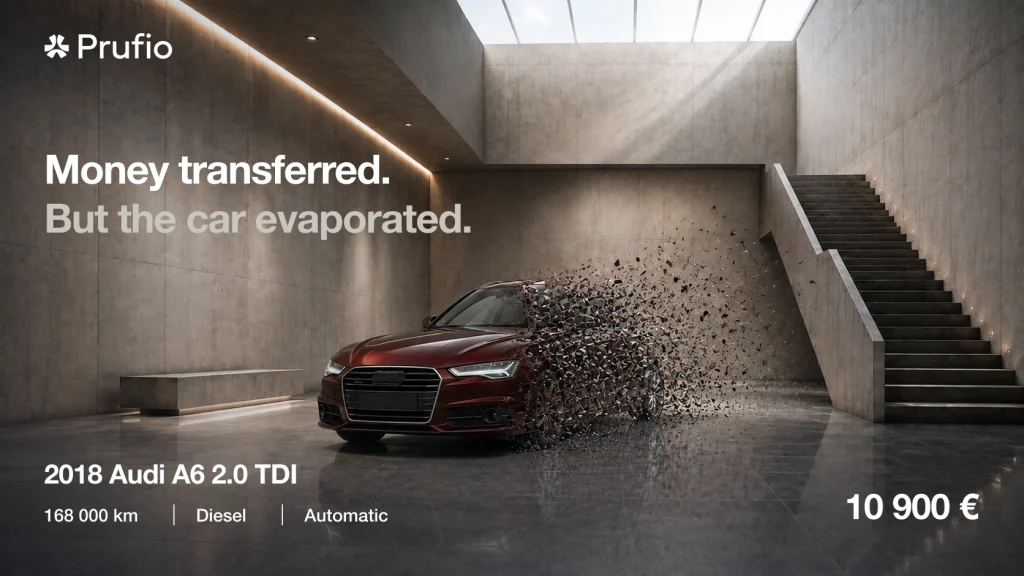
The listing looks professional. The photos show a car in good order, and the seller answers questions in detail. The conversation moves to WhatsApp or another messaging app. There the seller sends even more photos and videos of the car, along with the VIN and copies of the documents.
Then it turns out that other people are interested too, so to reserve the car you need to transfer a deposit today. But the seller may not have that car at all.
Fake car listings are not only a problem when buying from abroad. The same risk arises when the listing says the car is in another city, or simply too far away for you to view it today.
The material scammers send does not necessarily look forged. It can be taken from another listing, obtained from the real owner, or recorded long before. However many files you receive, they do not prove that the person who sent them can show you that particular car right now.
How do fake car listings work?
Car-buying fraud often starts quite innocently. The scammer gradually earns the buyer’s trust, until a deposit for the car begins to look like an ordinary part of the buying process.
The seller looks trustworthy. The scammer poses as a genuine car dealer or one of its employees, hides behind the name of a real company, or invents a seller that does not exist.
The listing shows an attractive price. It may be below the market price of similar cars, but not necessarily so low that it raises suspicion straight away. The photos are good quality and the technical details look realistic.
The seller sends more material. Through messaging apps the buyer receives additional photos and videos, the VIN, and pictures of the dashboard and the documents. Sometimes an invoice or a draft contract is sent as well.
A reason to hurry appears. The seller explains the purchase and delivery process in detail, but at the same time points out that other people are interested in the car. The deposit is requested so that the car is reserved for you and the listing is taken down.
Asked to show the car, the seller dodges. Instead of showing the car as the buyer asked, they send even more material prepared earlier. Once the money is transferred, contact is lost and the car is never delivered.
The amount requested may be called a reservation, transport or document-preparation fee. The name does not change the risk: the money is requested before you have established that the seller can show the car at all.
This happens in Lithuania too
The same schemes keep recurring in Lithuania. According to Utena County Police, on 17 June 2026 a man found a BMW for sale on a classifieds portal, agreed terms with the seller and made two transfers to the account the seller gave. Afterwards the seller could no longer be reached. The loss was 3,760 euros. Utena County Police incident report
The sums can be far larger. In April 2026 a man from Šiauliai found two cars for sale on a classifieds portal and transferred 17,800 euros for both from his sole proprietorship’s account to the seller. He received neither the cars nor his money back, and the seller became unreachable. Šiauliai County Police incident report
Company details, a contract and a bank account opened in the company’s name likewise do not prove that the car actually exists. In February 2026 Klaipėda County Police announced that it had referred a case of systematic fraud to court. The man is suspected of having offered cars and car parts online fictitiously in the name of a small partnership he had set up. Five people who responded to the car listings signed deposit agreements and transferred 1,000–2,000 euros each into the company’s account. In this way a total of 8,600 euros is suspected to have been taken from seven victims. Klaipėda County Police statement
Companies are affected too, and in individual cases their losses run to tens of thousands of euros. In October 2025 a company in Šiauliai transferred 37,196 euros for a Mercedes-Benz GLE, following an online listing, to the account the seller gave. The company never received the car, and the seller became unreachable. Šiauliai County Police incident report
“The car is abroad” is an old scheme that is still in use. In 2021 the head of a Šiauliai company found a 2018 Audi A6 for 14,900 euros on Autoplius, supposedly belonging to a Swedish company renewing its fleet. Having received confirmation of the reservation, the buyer transferred 4,500 euros from the company account to a private individual’s account. The seller explained that in Sweden money can also be transferred to a private person. The next day the buyer transferred the remaining sum and sent a car transporter to collect the vehicle. But the driver who travelled to Stockholm found neither the stated lot nor the car, and the supposed seller could not be reached afterwards. Lithuanian Police statement
Fake car listings are a global problem
These schemes recur across different European countries and in the USA. These are not old or isolated cases – most of the warnings and incidents mentioned below were published in 2026.
In the simplest version of the scheme there is no car at all. In August the Pforzheim police in Germany warned about listings in which neither the cars offered nor their supposed sellers existed, yet a deposit was requested before any viewing. Both private buyers and car dealerships fell victim to these schemes. Süddeutsche Zeitung / dpa report In March the Bulgarian police also reported fake listings for cars and vans being sold in a hurry. Once buyers had transferred a deposit, the sellers broke off contact. Bulgarian Police statement
Documents and a contract can strengthen trust, but they do not prove that the car exists or that the seller has the right to sell it. In Poland in July a buyer received a vehicle data report and a purchase agreement for a Mercedes. He transferred a deposit of 35,000 zlotys and only then noticed that the identification number written in the contract did not match the VIN. The seller promised to correct the error, but eventually stopped replying. Polish Police statement In June the Ukrainian cyber police warned that scammers create artificial interest among buyers, ask for a deposit to reserve the car, and, to reinforce trust, may send forged copies of registration certificates or other documents. Ukrainian Cyber Police warning
Sometimes it is not only the listing that is forged, but the entire sales environment. Volkswagen and Volkswagen Financial Services warned about forged websites, car catalogues, contact details and bank details used by scammers in Germany, Austria and Switzerland. Volkswagen published a list of 29 domains linked to this scheme. Volkswagen Financial Services warning and the official Volkswagen statement In September the US Federal Trade Commission (FTC) warned that scammers, often using artificial intelligence, clone the websites of genuine dealers, complete with logos, car listings, photos and customer reviews. When buying a car remotely, the FTC advises using an independent vehicle inspection service and treating a seller’s refusal to allow the car to be checked as a serious warning sign. The original FTC warning
Losses can run to tens of thousands of euros. In one case recorded in Germany a woman transferred about 41,000 euros to a supposed car dealership, but never received the car. DIE ZEIT / dpa report
Fraud schemes can also operate internationally. In 2022 Eurojust helped the Czech and Romanian authorities stop a scheme in which almost 200 victims lost about 1.6 million euros. They were asked for deposits of 4,000–8,000 euros for cars supposedly being brought in from abroad, ostensibly for customs procedures and transport. The scammers used 28 fake identities of Slovenian car owners and fictitious profiles of German companies. Eurojust statement
Checking a car before buying: where to start?
A remote car inspection is the first screening step – before travelling to view the car, paying a deposit, arranging transport or hiring a specialist for a full technical inspection. Its purpose is to answer a simpler question: can the seller show the very car offered in the listing, and does the visible information match the description?
This applies equally whether the car is offered in another city or abroad. Doubtful options can be ruled out before spending money on travel, transport, a local specialist’s services or a detailed diagnostic check of every car under consideration.
Before continuing with the deal:
Ask to be shown the specific car. Not to be sent even more files, but to be shown it in response to a request you initiate. Order a remote car inspection: during it the seller records the car as the app instructs, not as suits them.
Compare the data. The VIN, mileage, colour, specification and other features visible during the inspection must match the listing and the documents.
Check the seller and their right to sell. Look up the company’s details and contacts yourself in the official registers of the country where it is registered. Separately check the car’s ownership, any restrictions in force and the seller’s authority. The fact that a person showed the car does not yet mean they have the right to sell it.
Make sure you are paying the party that is selling. The seller, the party to the contract and the account holder must be the same person or company. If you are asked to transfer money to a different recipient, do not pay until you receive a clear and verifiable explanation. Even matching recipient details do not prove that the car actually exists.
Only then order a full inspection. Check the history of a car you are seriously considering separately, and its technical condition at a garage of your choice or with an independent specialist.
How does Prufio help in this process?
Prufio is not another request to send photos through a messaging app. The buyer sends the seller a structured remote inspection request, and the Prufio app guides the seller through the whole process and specifies what to record. Photos and videos are taken only during an active session. Material made earlier cannot be uploaded from the phone’s gallery, and timestamps and location data are recorded alongside.
The buyer receives a structured Prufio report with the material recorded during the inspection, the VIN, the mileage, visible defects, the seller’s answers and photos of the documents, if the seller provides them. From it you can see whether the seller was able to show the specific car and whether what they showed matches the listing. For an honest seller the inspection takes only a few minutes and lets them dispel the buyer’s doubts in one place.
And what if a scammer carries out the inspection? A copied listing, someone else’s photos or documents will no longer be enough: they will need access to a real car and to record during the session what the app asks for. The report data becomes a second layer of checking: you compare the location, time, VIN and mileage with the listing and the documents, while the seller, their right to sell and the payment recipient are checked separately. This makes the simplest scheme – where the seller cannot show the car at all – considerably harder, but it does not remove every risk: a person may show a real car that is not their own.
Not every seller who does not carry out an inspection is a scammer. But refusing to show the specific car through an inspection you initiate is a serious warning sign. In that case do not pay a deposit. You do not lose the inspection credit: if the inspection is not carried out, it returns to your Prufio account and can be used to check another car.
Frequently Asked Questions
It is risky. A professional listing, photos, videos or a contract that have been sent do not prove that the seller has the car and can sell it. Before paying, first make sure that the seller can show the specific car, and carry out the other checks discussed in this article.
Ask the seller to carry out an inspection you initiate and to record the specific car during it. Prufio inspection material is recorded only during an active session, so files made earlier cannot be submitted from the phone’s gallery as a new inspection.
Do not transfer any more money. Contact your bank or other payment service provider immediately and report it to the police. Keep the listing, the correspondence, the contracts, the payment details and all other material related to the transaction.
A listing can be created. A car has to be shown.
Do not rush. Check. Make sure.
Before spending more time or money, make sure the seller can show the very car they are offering.