You drive 200 kilometres. In the listing, the car looked flawless: glossy paint, tidy interior, “never been in an accident.” When you arrive, you find bubbling paint along the sill, a worn steering wheel, and panel gaps between the wing and the door that clearly don’t line up. The trip, the fuel and half a day off – wasted.
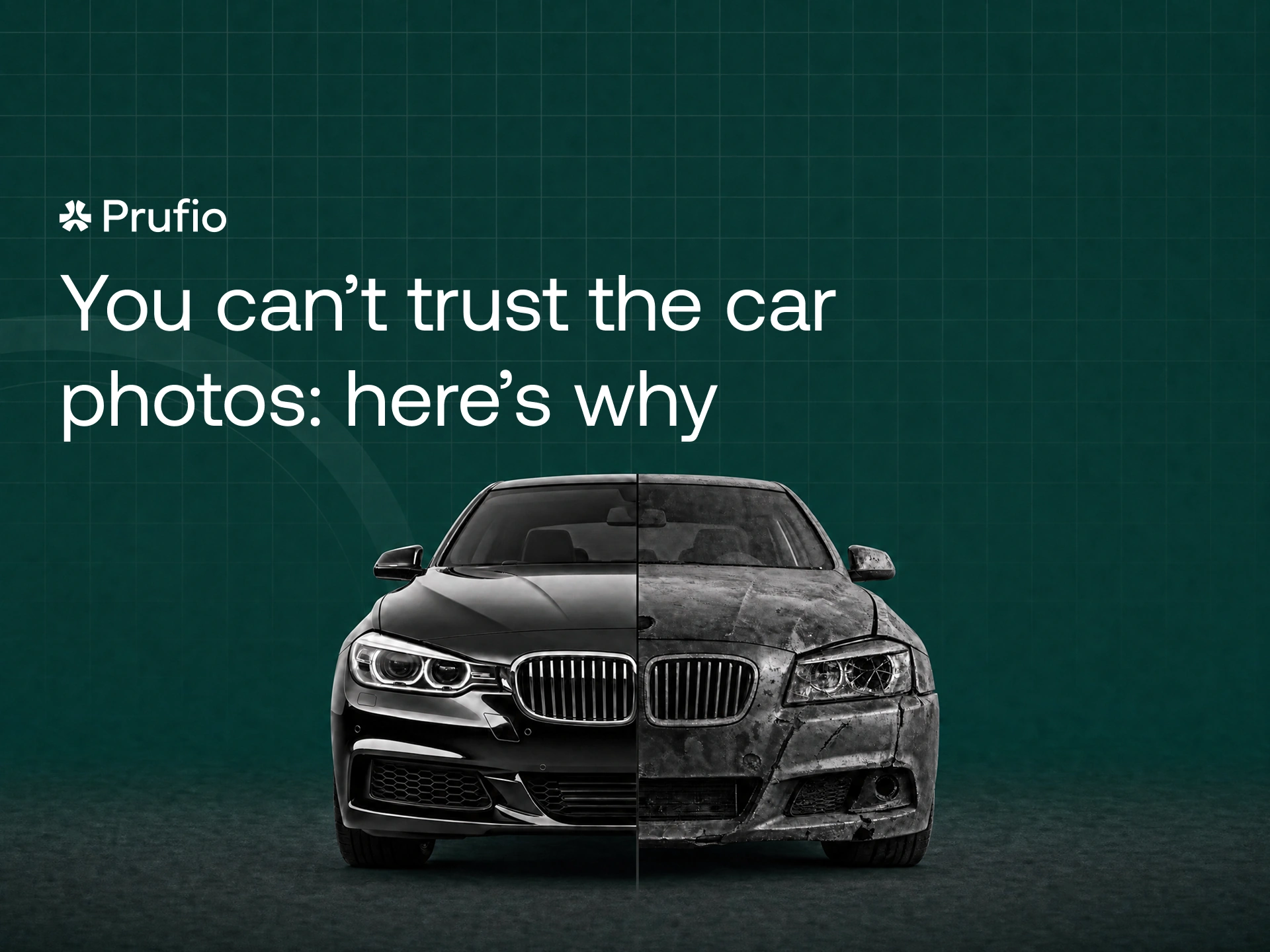
This happens every day. Not because buyers are careless, but because car photos in a listing are a marketing tool, not a condition report. Their job is to sell an emotion and get you to call – not to show what the car actually looks like.
Below: why car photos fool even a trained eye, which tricks you can spot before you travel, and what can realistically be verified remotely.
Why do good listing photos fail to show the truth?
A photo is a two-dimensional image, while body defects are three-dimensional. A dent, a wavy resprayed wing or an uneven panel gap only become visible when light hits at the right angle. The seller controls exactly that: when, where and how the photos are taken. Even with no bad intent at all, the result will almost always look better than reality.
Angle and lighting: how body defects get hidden
Three techniques do most of the work:
- A wet car straight out of the wash. A film of water fills in fine scratches and reflects light in a way that makes shallow dents effectively invisible.
- An overcast day or shade under a tree. There’s no point light source to reveal an uneven surface. The same car photographed in direct sun looks completely different.
- Shooting from a distance and a low angle. Perspective stretches the car and makes it look sharper, while defects shrink to a few pixels.
What to ask for instead: shots in daylight, on a dry body, from 1–2 metres, taken along the length of each side so the full reflection is visible.
Digital retouching and filters
Even when a seller edits nothing on purpose, the phone does it for them. Modern image processing automatically smooths surfaces, reduces noise, sharpens edges and boosts colour. Fine scratches and matte respray patches simply disappear.
Where the editing does become deliberate: the instrument cluster. Removing a check engine, ABS or airbag light from a photo takes under a minute. That’s exactly why one dashboard shot with the engine running and the odometer visible is worth more than ten body shots – and exactly why it’s so often missing.
The “magic” interior refresh
Cleaning chemicals and plastic dressings recreate the look of a new interior in photos. But wear stays visible where dressing doesn’t help:
- a worn steering wheel cover at the 10 and 2 positions;
- a collapsed, cracked driver’s seat bolster;
- worn rubber on the brake and clutch pedals;
- a gear lever surround polished smooth by use.
If the listing states 90,000 km but the wheel and pedals look like a quarter of a million, something doesn’t add up. And this is almost always visible in the photos – you just have to look at the right places.
The most common seller tricks you can spot in photos
The good news: a lot of problems surface before you even call, if you read the listing as a document rather than a catalogue.
Certain sides of the car are missing
A complete set should cover all four corners, both sides, front, rear, engine bay, boot, all four seats, the dashboard and the wheels. If one specific angle is missing, that’s usually where the problem is.
Be especially wary when there’s no shot of the driver’s seat (wear), the left-hand side (city scrapes, bollard marks) or the engine bay (leaks, mismatched parts after a repair).
Old photos or photos from different seasons
Fallen leaves on the ground, but it’s June? Wet road in one photo and dry in the next? Different background across shots? That means one of two things: the listing has been up for a long time (so price and condition no longer match) or the photos were taken before a particular event.
Watch the small details too: a windscreen sticker in a different position, different tyre tread, a different registration plate between shots.
Panel gaps and non-original parts
Factory panel gaps are even along their full length. If the gap between the wing and the door is narrower at one end than the other, the car has been apart or straightened.
It’s also worth zooming in on the headlights: they carry a manufacturer logo and a production date. If one is newer than the other, or from a different manufacturer, the car had a front-end impact – whatever the listing says.
How to avoid disappointment and financial loss
The only way not to get this wrong is to work from facts rather than images. Three steps, best taken in this order.
1. Ask for additional shots or video
An honest seller will have no problem filming a specific area, showing a cold start or the instrument cluster. A refusal is an answer in itself.
There’s a catch, though: simply asking to “send more photos” guarantees nothing. You get a file in a message with no way of knowing when it was taken, where, or whether it’s even the same car. The photo could be six months old, edited, or lifted from another listing for the same model.
This is the gap Prufio closes. The buyer sends a request and the seller runs a guided inspection on their own phone: photos and video are captured inside the app only, with no option to upload from the gallery. Every capture is tied to a timestamp and a location, and the report includes a Location TrustScore.
It takes the seller 5–10 minutes. You get a structured report covering exterior, interior, VIN, odometer and a video walkthrough – plus clear confirmation that everything was captured in a single session rather than assembled from old files.
It doesn’t replace a physical inspection. It does let you rule out the wrong cars before you spend anything on fuel and before you leave the house.
2. Check the vehicle history against the VIN
The VIN is a 17-character code visible through the windscreen, on the driver’s door pillar and in the registration document. First step: make sure the VIN in the photos matches the one the seller gives you in writing.
Some information is free. VIN decoders reveal factory specification, engine code and other basic vehicle data, and national registers let you check core registration details and insurance status. If you’re looking for a free vehicle history check, that’s realistically what you get: technical data and current status, but not the past.
A full history report is usually paid. Services such as autoDNA and carVertical show accident records, mileage readings logged across different countries and, in some cases, auction photos from the US or Europe – the ones taken right after a crash. A single image like that is often enough to make a “no damage” listing irrelevant.
One limit worth understanding: a VIN check shows the past, not the present. A report won’t tell you whether the car starts today, whether the interior smells of damp, or whether it picked up damage in a car park last week. So a VIN-based vehicle check and a real-time inspection don’t replace one another – they cover different periods.
3. Never skip the physical inspection
Before you sign, get a pre-purchase inspection at a workshop. Two parts matter most:
- Paint thickness measurement. A factory layer is typically 80–150 µm. Readings above 300 µm indicate a respray or filler, and a large difference between adjacent panels points to a repaired area.
- Diagnostics. A fault code scan shows not only current faults but also whether codes were cleared shortly before the viewing. Add a lift inspection for rust, suspension condition and fluid leaks.
This costs a few dozen euros. Set against one hidden engine or automatic gearbox fault, it’s the cheapest part of the whole purchase.
Why this matters
Car photos in a listing aren’t a lie – they show the best possible version of what the seller wants to sell. The problem starts when a buyer treats them as evidence.
The practical approach is simple: photos help you build a shortlist, facts help you choose. A remote real-time inspection shows current condition, a VIN report shows history, and a workshop confirms the mechanical side. Three separate sources the seller doesn’t control.
FAQ
Look at how even the panel gaps are, whether paint shades differ between panels, tyre wear, whether interior wear matches the stated mileage, and whether every corner of the car has been photographed. The missing angle usually tells you more than all the ones shown.
Not always – plenty of people shoot straight after a wash simply because the car looks better. But a wet body reflects light and hides fine scratches, paint defects and shallow dents well. Treat those photos with more caution and ask for shots on a dry body.
The best route is a VIN check through a vehicle history service. If an accident was recorded or the car came through an auction, the report often includes photos taken right after the damage. It’s the one source a seller can’t edit.
Yes, it’s completely normal. An honest seller will have no problem filming the area you’re asking about or the engine running. A refusal usually means something is being kept out of frame.
Partly. Ordinary photos and video guarantee nothing, because there’s no way to verify when or where they were taken. Remote inspection platforms such as Prufio solve that on the technical side: material is captured only during a guided in-app session, tied to a timestamp and a location, and delivered as a structured report. It doesn’t replace workshop diagnostics, but it does let you filter out the wrong cars before you travel.